

What Are the True Hidden Costs of Buying in NYC? A 2025 Expert Guide to Taxes, Fees, and Carrying Expenses
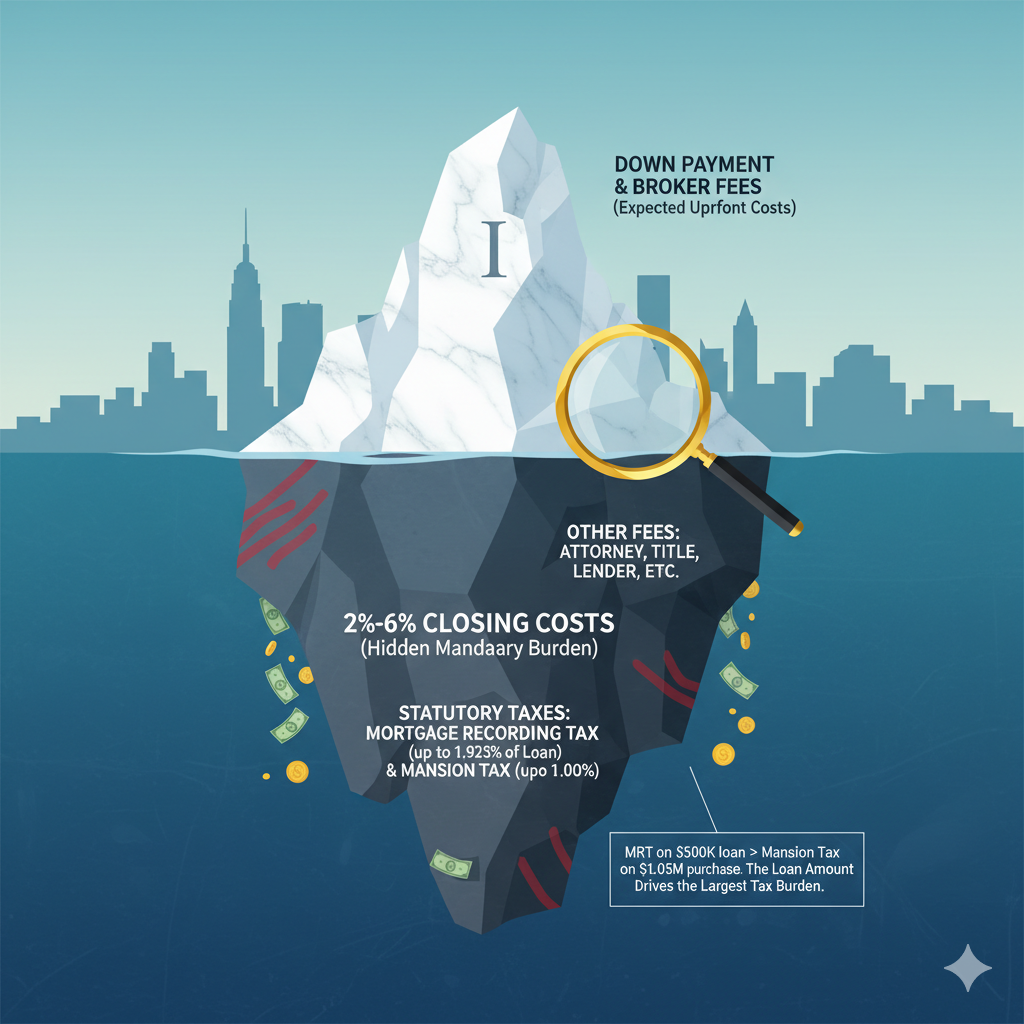
The analysis of NYC’s specific fee structure demonstrates that the choice between purchasing a co-operative (co-op) versus a condominium (condo) or townhouse determines a buyer’s upfront financial liability. Condos and houses, especially those financed with a mortgage, face statutory taxes—specifically the Mortgage Recording Tax (MRT) and the need for Title Insurance—that are largely nonexistent for co-ops.
I. The NYC Cost Crucible: Unmasking the "Hidden" Financial Landscape
Buying real estate in New York City is famously complex, characterized by unique statutory requirements and fees that often blindside even financially sophisticated buyers. While the down payment and mortgage principal capture most of the initial attention, the true barrier to entry often lies in the volume and progressive nature of the secondary expenses—the hidden costs.
These additional costs are formally categorized as "closing costs," which are the statutory taxes, administrative fees, and legal charges paid by both buyers and sellers to finalize a transaction, entirely separate from the home's purchase price.The financial exposure is significant: while seller closing costs are predictably steep, often ranging from 8% to 10% of the sale price , buyer closing costs present a much wider variance, falling anywhere from 1.5% to 6% of the purchase price.
This vast range in buyer costs is not accidental; it is driven almost entirely by strategic decisions regarding property type and financing. A buyer's budget forecasting must contend with two major financial hurdles: the immediate, one-time closing costs paid at the table, and the ongoing, variable "carrying costs"—the monthly maintenance or common charges, coupled with the lurking threat of unexpected assessments and future tax surges.
The analysis of NYC’s specific fee structure demonstrates that the choice between purchasing a co-operative (co-op) versus a condominium (condo) or townhouse determines a buyer’s upfront financial liability. Condos and houses, especially those financed with a mortgage, face statutory taxes—specifically the Mortgage Recording Tax (MRT) and the need for Title Insurance—that are largely nonexistent for co-ops. This single factor necessitates a deep, strategic dive into how these taxes are levied and how they can be mitigated, positioning the buyer to make the most cost-effective decision before they even sign a contract.
II. Buyer Closing Costs: The Upfront Financial Shockwave (Taxes and Fees)
The initial closing table presents buyers with a combination of non-negotiable statutory taxes and necessary professional fees. For buyers focused on the median NYC home price, these costs can easily reach six figures, demanding precise budgeting.
A. The Three Tax Titans: Statutory Costs for the Buyer
1. The Progressive Mansion Tax (MT): Calculating the Progressive Burden
The Mansion Tax is arguably the most recognizable of the buyer-paid transfer taxes. It is a mandatory, non-negotiable transfer tax levied by New York State, and is customarily borne entirely by the buyer. This tax applies to all residential property purchases—including co-ops, condos, and houses—where the sale price is $1,000,000 or greater.
The Mansion Tax utilizes a tiered, progressive structure. Unlike its previous flat-rate iteration, the tax rate increases incrementally, starting at 1.00% and rising up to a maximum rate of 3.90% for transactions valued at $25 million or higher. This tiered structure creates major budgetary pressure points near the thresholds. For instance, a property sold for $1.8 million incurs a 1.00% tax, resulting in an $18,000 expense. However, a slight price jump to $3.5 million triggers the 1.50% rate, driving the tax expense to $52,500. Buyers must be acutely aware of which threshold their target purchase price falls into to avoid costly surprises.
The progressive rates are structured as follows:
Table 1: NYC Mansion Tax Progressive Rate Schedule (Buyer Closing Cost)
| Purchase Price Range | Mansion Tax Rate |
|---|---|
| $1,000,000 to $1,999,999 | 1.00% |
| $2,000,000 to $2,999,999 | 1.25% |
| $3,000,000 to $4,999,999 | 1.50% |
| $5,000,000 to $9,999,999 | 2.25% |
| $10,000,000 to $14,999,999 | 3.25% |
| $15,000,000 to $19,999,999 | 3.50% |
| $20,000,000 to $24,999,999 | 3.75% |
| $25,000,000 or greater | 3.90% |
2. The Mortgage Recording Tax (MRT): Financing Fees That Disappear for Co-ops
For buyers financing a condominium or house purchase in NYC, the Mortgage Recording Tax (MRT) is often the single largest upfront closing cost. This tax is applied to the loan amount, not the purchase price, and the effective rate paid by the buyer is determined by the mortgage size.
For residential loans below $500,000, the effective MRT rate is 1.8%. For loans of $500,000 or more, the effective rate increases to 1.925%. (The total statutory tax rate is technically higher, but the lender customarily pays 0.25% of the total, reducing the buyer’s direct burden). This difference of 1.925% applied to a large mortgage amount represents tens of thousands of dollars in mandatory tax.
The strategic financial advantage of choosing a co-op becomes immediately apparent here: the MRT does not apply to co-op purchases. This exemption exists because a co-op purchase involves buying shares in a corporation and receiving a proprietary lease, rather than receiving a deed to real property and recording a mortgage against it. The immediate avoidance of this 1.925% tax on the loan amount provides a massive upfront cost advantage for co-op buyers, particularly those financing 75% or 80% of the price.
Moreover, sophisticated buyers of resale condos or houses should always inquire about a Consolidation, Extension, and Modification Agreement (CEMA) mortgage. Because the MRT is calculated based on new lending , a CEMA allows the buyer to assume the seller’s existing mortgage structure and only pay the MRT on the new funds borrowed. This strategy significantly reduces the tax base subject to the 1.925% rate, establishing a mechanism for strategic cost mitigation that can save a buyer tens of thousands of dollars at closing.
3. The Transfer Tax Twist: When Buyers Shoulder the Seller’s Burden
The NYC Real Property Transfer Tax (RPTT) and the NY State Transfer Tax are generally considered seller expenses in a typical residential resale. For residential sales exceeding $500,000, the NYC RPTT is 1.425% of the price , and the NYS Transfer Tax is typically 0.4% (or 0.65% for sales over $3 million).
However, a major hidden cost arises in transactions involving new construction (often called "sponsor units"). In these deals, the developer (sponsor) often contracts stipulating that the buyer must cover both the NYC RPTT (up to 1.425%) and the NYS Transfer Tax. This contractual shift immediately increases the buyer’s closing costs by up to an additional 1.825% of the purchase price, on top of all other taxes and fees. This is a non-negotiable premium for new development properties, pushing total buyer closing costs well over the 5% threshold. Buyers must integrate this liability into their pre-offer budgeting for new construction.
B. Essential Non-Tax Fees: Legal, Title, and Loan Costs
1. Title Insurance: Protecting Your Investment
Title insurance is mandatory for purchases of condos and houses but is generally not required for co-ops. This insurance protects both the lender and the owner against potential defects in the property title, such as undisclosed liens, ownership disputes, or legal challenges.
The total title expense is complex, encompassing the Owner’s Policy Premium, the Lender’s Policy Premium, and various necessary search and endorsement fees (including Municipal Searches, Patriot Act searches, and Bankruptcy searches).Collectively, these fees typically amount to between 0.4% and 0.6% of the property's purchase price. This cost is another reason why co-op purchases offer a lower upfront barrier to entry compared to their condo counterparts.
2. Legal Expertise: Negotiating the Attorney Fee
Given the specific complexities of NYC real estate, obtaining legal representation is essential. Real estate attorney fees for standard residential purchases typically range from $2,500 to $3,500.
This range can escalate quickly based on the property's value and complexity. Luxury transactions often see fees between $3,500 and $5,000 , and deals involving complex legal issues may be charged hourly, ranging from $150 to $500 per hour.Buyers should confirm whether the fee quoted is a flat rate covering the entire transaction or if it shifts to an hourly rate should unforeseen complications arise.
3. Lender Requirements: Appraisal and Origination Fees
For any transaction involving financing, a separate set of bank fees is generated. These include the Loan Origination Fee (typically 0.5%–1% of the loan amount), the Appraisal Fee ($500–$1,000), and a Credit Report Fee ($25–$100).
Furthermore, the buyer is responsible for paying the Bank Attorney Fee ($600–$1,000), which covers the cost of the attorney hired by the lender to prepare and review the necessary closing documents and represent the bank's interests at the closing.
III. Co-op vs. Condo: A Financial Closing Cost Showdown
The choice between a co-op and a condo is the single most important decision impacting a buyer's upfront budget. Co-ops generally offer significantly lower closing costs, compensating for the stricter financial scrutiny and ownership restrictions they impose.
A. The Co-op Advantage: Lower Upfront Costs (1.5%–3% Range)
Co-op buyers often budget for closing costs in the range of 1.5% to 3% of the purchase price, a comparatively modest burden. This savings is almost entirely attributable to the absence of the MRT and Title Insurance liability. The primary fees for a co-op buyer are administrative and professional: the buyer’s attorney fees, co-op application fees (which can reach $500+), move-in fees (which can be refundable deposits or non-refundable charges), and fees related to financing preparation.
B. The Condo Surcharge: Higher Upfront Costs (2%–5%+ Range)
Condominiums and houses typically fall into a higher closing cost range of 2% to 5% for resale properties, soaring to 5% to 6% or more for new construction. This spike is due to the mandatory inclusion of the MRT and Title Insurance, in addition to the Mansion Tax. Administrative fees for condos also include Board Application Fees and Move-In Fees.
The immediate financial impact of this disparity is significant. If a buyer finances 80% of a $1.5 million condo, the MRT alone is approximately $23,100, which is pure savings for a co-op buyer. The upfront closing cost relief offered by a co-op helps offset the typical trade-offs associated with co-op ownership, such as lower liquidity and greater oversight from a co-op board.
The comparison of costs illustrates the dramatic structural differences:
Table 2: NYC Buyer Closing Costs Comparison: Co-op vs. Condo/House (Financed)
| Cost Component | Condo/House (Financed) | Co-op (Financed) | Significance |
|---|---|---|---|
| Mortgage Recording Tax (MRT) | 1.8% – 1.925% of Loan Amount | $0 (Exempt) | Largest variance based on financing/property type. |
| Mansion Tax | 1.00% – 3.90% of Purchase Price | 1.00% – 3.90% of Purchase Price | Applies to all residential sales over $1M. |
| Title Insurance & Searches | 0.4% – 0.6% of Purchase Price | Usually N/A | Mandatory for deeded real property. |
| Transfer Taxes (Sponsor Unit) | 1.4% – 1.825% of Purchase Price | 1.4% – 1.825% of Purchase Price | Liability shift in new construction. |
| Legal/Bank Fees | $3,500 – $6,000+ | $3,500 – $5,000+ | Includes attorney, appraisal, and lender fees. |
| Total Estimated Range | 2% – 5% (Resale); 5%–6%+ (New Dev.) | 1.5% – 3% | Strategic choice between upfront cost types. |
C. The Hidden Fee of Financial Health: Capital Contribution and Working Capital Funds
Beyond the statutory costs, many co-ops and condos impose a one-time fee at closing known as a Capital Contribution Fee or Working Capital Fund. This is a payment made directly to the building's corporation, entirely separate from the seller's proceeds.
The purpose of this fee is vital: it helps replenish the building's cash reserves, ensuring sufficient capital is available for major, long-term repairs like roof replacements or boiler upgrades. By actively generating revenue upon transfer, the building reduces the necessity of issuing sudden, financially debilitating special assessments to existing owners down the line.
This fee is typically calculated in one of two ways: either as a flat fee (e.g., $1,500–$5,000) or, more commonly, as a multiple of the monthly charges, often equivalent to 1 to 3 months of maintenance or common charges. A building that proactively requires a substantial Capital Contribution is often demonstrating sound financial stewardship. While the buyer faces a higher upfront cost, they are acquiring an interest in a more fiscally stable entity, mitigating the risk of inheriting deferred debt or future emergency assessments.
It must be noted that while co-ops offer lower upfront closing costs, this advantage is counterbalanced by an extremely stringent approval process. Co-op boards demand high liquid reserves (often 12 to 24 months of mortgage and maintenance payments held in cash after closing) and strict debt-to-income (DTI) ratios, often requiring DTI to be at or below 25%–30% of gross income. This intense scrutiny is necessary because the shareholder group is collectively liable for the building’s finances, mortgage, and underlying expenses. The lower upfront cost is exchanged for a higher hurdle in financial eligibility and due diligence.
IV. Ongoing Expenses: The Long-Term Carrying Cost Trap
The true "hidden costs" of NYC ownership manifest not just at closing, but in the long-term, unpredictable nature of monthly carrying expenses and future tax liabilities.
A. Decoding the Monthly Bill: Maintenance vs. Common Charges
1. What Co-op Maintenance Covers (Bundled Costs)
Co-op owners pay a single monthly Maintenance fee. This fee is "all-in," covering the operational expenses of the corporation, including building staff salaries, insurance, utilities (often heat and hot water), and contributions to reserves.Crucially, co-op maintenance fees include the owner’s proportional share of the building’s property taxes and the underlying building mortgage (if one exists).
This bundling provides a significant financial advantage: the portion of the maintenance fee attributable to property taxes and mortgage interest is tax-deductible for the shareholder. Market data shows that co-op maintenance averages around $2.44 per square foot (psf) in Manhattan.
2. What Condo Common Charges Cover (Unbundled Costs)
Condominium owners pay Common Charges (often called HOA fees) separately from their property taxes. Common charges cover shared expenses like staff payroll, insurance, common area maintenance, and reserve contributions. Condo owners receive a separate, quarterly bill from the city for their individual unit’s property taxes.
Condo common charges, averaging about $3.20 psf in Manhattan, may appear higher than co-op maintenance on paper.Furthermore, the common charges themselves are generally not tax-deductible, though the separately paid property tax and mortgage interest are.
This comparison is often misleading. While the per-square-foot common charge rate is higher for a condo, a direct comparison requires analyzing the after-tax, all-in monthly cost. Since co-op owners can deduct the embedded property tax portion of their maintenance, their net housing cost may end up being comparable to, or even lower than, a condo owner who pays high monthly common charges plus a separate, non-trivial property tax bill. Buyers must request the building’s financial statements to determine the tax-deductible percentage of maintenance before making assumptions based on listed psf rates alone.
B. The Threat of Special Assessments: Budgeting for the Unforeseen
One of the most disruptive hidden costs is the Special Assessment. This is a temporary, additional charge levied against owners or shareholders to fund unexpected, major capital projects or cover severe operating shortfalls that were not provisioned for in the building's regular budget. They are a clear signal that the building’s capital reserve fund was inadequate to meet large-scale, unforeseen expenses, such as a major façade restoration or boiler replacement.
Special Assessments are calculated differently based on property type: in co-ops, the assessment is typically divided based on the number of shares owned, reflecting the unit's relative size and value. In condos, assessments are calculated based on the unit’s proportional share of the building’s common elements, usually correlating directly to the square footage. In both cases, larger units bear a proportionally heavier financial burden.
The history of Special Assessments is a critical factor in due diligence. A pattern of frequent assessments indicates that the building’s board has mismanaged its finances, failed to anticipate necessary repairs, or kept monthly fees artificially low. This means the buyer is essentially inheriting a form of deferred debt. A building with robust, well-funded reserves is financially sounder because the board can cover costly unexpected events without issuing a sudden financial shock to owners.
A nuance specific to co-ops is the "tax abatement assessment." This is sometimes implemented by co-ops to capture the funds provided by the city's Cooperative and Condominium Tax Abatement program, diverting those savings directly into the building's reserves or operating budget. This method ensures the building’s financial health without forcing shareholders to pay extra out of pocket.
C. The Abatement Time Bomb: Planning for Property Tax Surges
A final, often miscalculated long-term expense involves property tax abatements, commonly seen in new luxury condo developments (such as 421a or 421g programs). These abatements offer temporary property tax relief, sometimes zeroing out tax liability for up to 10 years.
However, these tax breaks are temporary and phased out according to a set schedule. For example, a 421g abatement might see taxes rise to 20% of the normal rate in year 11, 40% in year 12, and so on, until the full 100% tax liability is reached in year 15.
Buyers frequently qualify for financing based on the current, artificially low monthly carrying costs. When the abatement expires (the "sunset"), the sudden surge in property taxes—which can represent hundreds or thousands of dollars monthly—can create a massive, unforeseen affordability crisis. Furthermore, the high future carrying costs can price out subsequent potential buyers, leading to difficulty in resale or a correction in the property’s market value. Responsible financial planning requires buyers to calculate the property tax liability at the point the abatement phases out and ensure they can afford the full, non-abated rate in their long-term budget.
V. The Seller’s Cost Context: Insight for the Savvy Buyer
While this report focuses on buyer costs, understanding the substantial expenses incurred by the seller (typically 8% to 10% of the sale price) provides crucial leverage for negotiation and contextualizes market pricing.
A. Broker Commissions: The Largest Single Expense
Broker commissions represent the largest single outflow for the seller. In NYC, the total commission paid by the seller is typically split between the seller's agent and the buyer's agent, and the average total rate hovers around 5.50% to 5.76% of the sale price. Since commission is calculated on the gross sale price, this figure immediately consumes a significant portion of the seller’s net proceeds. It is worth noting that National Association of Realtors data suggests that this cost is on average recouped in the typically 11.5% higher sale price that than of homes listed as For Sale By Owner.
B. The Seller’s Taxes: Transfer Taxes and Thresholds
Sellers are responsible for both the state and city transfer taxes in a standard resale.
NYC Real Property Transfer Tax (RPTT): For residential sales exceeding $500,000, the seller pays 1.425% of the sale price.
New York State Transfer Tax: Sellers typically pay 0.4% of the purchase price, rising to 0.65% for sales of $3 million or more.
These taxes further constrain the seller’s potential net profit, reinforcing the financial pressure they face when considering offers.
C. The Co-op Flip Tax: A Transfer Fee Usually Paid by the Seller
In co-op sales, and occasionally in condo transactions, the building imposes a Flip Tax upon the transfer of ownership.This fee is generally intended to benefit the building’s financial health and curb speculation.
The average flip tax ranges from 1% to 3% of the gross sale price, though certain high-end or specialized co-ops may charge up to 3.5%. While the payer is sometimes negotiable, the flip tax is almost universally the seller’s responsibility. It can be calculated as a percentage of the gross price, a flat dollar amount per share, or even as a percentage of the seller's net profit.
Paradoxically, while this fee reduces the seller's proceeds, it provides a benefit to the buyer. By ensuring that capital contributions are constantly replenishing the building’s reserves, a well-managed flip tax helps fund major repairs and maintain financial liquidity, which leads to more stable monthly maintenance fees for the new owner and mitigates the risk of sudden Special Assessments.
Table 3: Seller Closing Costs Context (Negotiation Leverage)
| Cost Component | Typical Percentage (of Price) | Impact on Buyer Strategy |
|---|---|---|
| Broker Commission (Total) | 5.5% – 6.0% | Represents seller's largest cost; potential for negotiation or rebate savings. |
| NYC RPTT | 1.0% – 1.425% | Buyer assumes this cost in new development deals. |
| NYS Transfer Tax | 0.4% – 0.65% | Buyer assumes this cost in new development deals. |
| Co-op Flip Tax | 1.0% – 3.5% | Must be factored into seller's net proceeds; impacts ability to accept a lower offer. |
| Total Seller Costs | 8% – 10% | Provides leverage; if the seller needs liquidity, they may be willing to cover minor buyer fees. |
Understanding the seller’s total closing cost outflow (8%–10%) is crucial for negotiation. If a property is slow to move, the seller, having limited net proceeds, may be more willing to concede on minor buyer fees (like contributing to the buyer's attorney fee or mortgage points) than to lower the asking price further.
VI. Expert Budgeting Strategies and Recommendations
Navigating the hidden costs of NYC real estate requires strategic action both at the closing table and in long-term financial planning. By focusing on mitigating statutory costs and diligently assessing long-term financial health, buyers can significantly reduce their overall exposure.
A. Maximizing Savings: Strategic Financial Maneuvers
Broker Commission Rebates: One of the most direct ways to offset buyer closing costs is through a broker commission rebate. Commission structures are negotiable, and certain agencies offer substantial rebates, in some cases up to 2% of the purchase price, which can be credited back to the buyer at closing to cover fees.
Utilizing the CEMA Mortgage Advantage: For buyers of resale condos or houses who are financing, the potential savings offered by a CEMA mortgage should be rigorously explored. By structuring the loan to assume the seller's existing mortgage liability, the buyer pays the Mortgage Recording Tax solely on the new portion of the financing, thereby minimizing the tax base and saving tens of thousands of dollars on this mandatory fee.
Targeted Negotiation: In markets where buyers have more leverage, the focus should shift from solely negotiating the purchase price to negotiating specific seller contributions toward the buyer's closing costs. Understanding the seller's 8%–10% financial burden provides the context needed to propose targeted concessions.
B. Due Diligence Checklist: Assessing Long-Term Risk
The stability of a building's financial foundation directly impacts an owner's long-term carrying costs. Robust due diligence is mandatory to avoid inheriting financial distress.
Review Reserve Funds: Buyers must always request and thoroughly analyze the building’s financial statements, specifically confirming the health and sufficiency of the capital reserve fund. A robust fund indicates the capacity to handle large, unexpected repairs without resorting to Special Assessments.
Analyze Abatement Timelines: For properties with tax abatements (such as new condos), the expiration date must be identified, and the long-term budget must factor in the full, non-abated property tax rate. Failing to budget for the tax "sunset" is a common financial pitfall.
Scrutinize Maintenance History: Examine the history of maintenance or common charge increases and any past Special Assessments. Frequent, large increases or a pattern of recent assessments signal potential underlying financial mismanagement and a high likelihood of future financial shocks.
C. Finalizing Your Budget: A Checklist for Success
Ultimately, budgeting for an NYC purchase involves planning for three distinct pillars of capital:
Upfront Funds: The Down Payment combined with the Buyer Closing Costs (expecting a range of 1.5%–6%).
Liquid Reserves: Budgeting for required liquid cash reserves after closing. Co-ops frequently require applicants to demonstrate 12 to 24 months of total carrying costs (mortgage principal, interest, taxes, and maintenance/common charges) held in liquid assets post-closing.
Future Buffer: Accounting for potential future property tax increases if purchasing a property with a tax abatement that is set to expire.
By strategically addressing the nuances of property type, tax liability mitigation, and comprehensive financial due diligence, buyers can navigate the complexity of the NYC market and accurately forecast the true, comprehensive cost of ownership.